
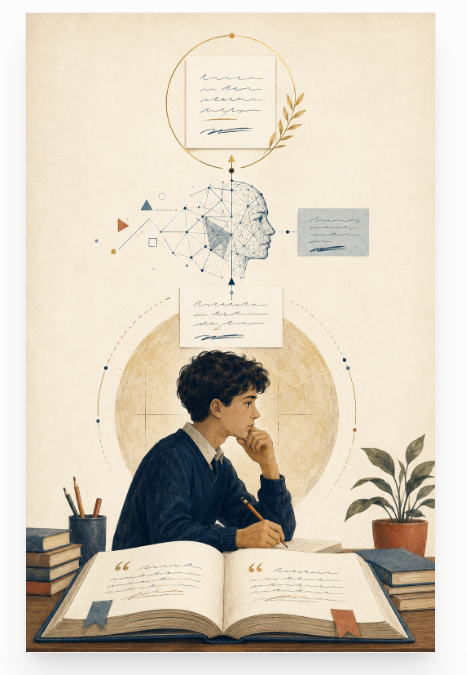
Every summer, I give my students Devoirs de vacances—summer homework—in mathematics, and ask them to read a book in French and another in English, each submitted as a full book report. This year, I also gave them a machine. We introduced it in the English report only, as a first, deliberate test of the idea before deciding whether it belongs anywhere else in the programme, and asked students to argue with it. It may be the most important thing I have done in education in a long time.
For the past few years, educators everywhere have been asking the same question: how do we stop students from using AI? We have built plagiarism detectors, revised assessment policies, and tightened our academic integrity rules. Students have continued to use AI anyway, because the tools are everywhere, they are free, and they work. I have come to believe we have been asking the wrong question. The right question is not how to stop students from using AI, but how to place a student’s own thinking in front of the machine’s, in the right order, so that the student remains the one doing the thinking. That question does not lead to surveillance and rules. It leads to a method of teaching that turns AI into a tool and the student into the mind that judges it. That idea sits at the heart of our summer reading programme this year.
When a student asks an AI tool to respond to a book—to summarize it, analyze its themes, or argue a position about it—something genuinely remarkable and genuinely limited happens at once. The AI aggregates. A language model has been trained on an enormous volume of writing—books, reviews, essays, criticism, and commentary of every kind—and its response is not a reading in the way a person reads. It reflects patterns drawn from everything of that kind it has encountered, flattened and smoothed into something like the collective, averaged interpretation of countless readers and critics. AI gives you the consensus—what has most commonly been thought and said, expressed in the most generally acceptable way. And the average of anything, by definition, belongs to no one in particular.
This is where the order of operations matters more than anything else in the assignment. If a student reads the AI’s take before forming their own, the consensus arrives first and quietly becomes the frame for everything that follows—even a sharp, independent-minded student will find it easier to react to a position already on the page than to build one from nothing. So in our programme, the AI does not speak first. The student does. Only once a student has committed something of their own to paper—a theme they noticed, a claim they are prepared to defend—are they permitted to bring a machine into the room at all. That single sequencing decision is, I think, the difference between a genuine exercise in independent thought and a glorified fact-check.
For our Grade 9 students, this is a first, carefully scaffolded encounter with that idea. They read their chosen book in full, then identify one theme or question the book raises for them and commit it to a single sentence—their own position, arrived at before any outside input. Only then do they turn to AI, posing it three substantive questions about that theme and recording its answers in full. The real work follows: for each response, the student writes an evaluation—what the AI captured accurately, what it oversimplified or missed, and where their own reading leads somewhere the AI’s did not go. From that foundation, they write a literary response in their own voice, grounded in at least two direct quotations from the text, and close with a short reflection on what the exercise showed them about the difference between a machine’s reading and their own.
Grade 10 students, who have a year of this practice behind them, are asked to go further. They read closely, then formulate an actual thesis—a specific, arguable claim about the work—before consulting AI in any form. Only once that thesis exists do they present it to an AI and ask it to do something more demanding than summarize: to mount the strongest objection it can to their claim, and to propose an alternative interpretation entirely. The student then answers back in writing, conceding what is genuinely valid in the machine’s objection and defending, or refining, their own position where it still holds. That exchange becomes the spine of a formal five-to-six paragraph literary essay in MLA format, complete with a Works Cited page—and here the policy is unambiguous: the essay must cite the primary work and one credible secondary source, a real critical essay or piece of published scholarship. The AI’s own words do not count as a source and may not appear in the Works Cited. It was a tool in the thinking, not a citation for it. The assignment closes with a critical reflection on AI as what I would call a literary sparring partner: where it sharpened the student’s thinking, where it fell short, and what a careful human reader can do that it cannot.
What both versions of the assignment are training, at different levels of demand, is a specific intellectual habit: form the judgment, then test it—never the reverse. That habit is worth far more than any single essay grade. A student who has learned to write down what they think before checking what the machine thinks has learned something that will serve them long after this book, and long after school. They have learned that the average is a fine place to start an argument and a poor place to end one, and that the questions worth asking of a powerful tool are never “what should I think,” but “where does my thinking hold up, and where do I need to go further.”
There is a lesson in all of this that goes well beyond literature. AI is extraordinarily good at the average—the expected, the conventional, the already-said. What it cannot do, and will never be able to do, is arrive at a text with the particular life of one reader: their memories, their summer, their private way of noticing things. That is what a reader is. That is what we are asking our students to remain, even as they learn to use the most powerful tools of their generation. The goal was never to raise students who can outperform AI at generating an answer. It is to raise students who know how to think before the machine speaks, and how to hold their ground afterward, with evidence, when it is right to do so.
I gave my students AI this summer, and asked them to form their own minds first and test the machine against them. What they bring back in September—theses defended, counter-arguments answered, and a citation page with not one AI-generated line in it—will be some of the most honest, most rigorous thinking they have done all year. I cannot wait to read it.